Design Features
Materials
The material used in the manufacture of our sluice gate complies with the requirements of DIN 19704 and under full static pressure there is ample safety margins. The frames, gates and fasteners are stainless steel to ASTM A276 grades 304 or 316 Inspection and material certificates for the stainless steel used in the fabrication of the sluice gates are available on request.
Seals
Sluice gates have a Neoprene rubber strip bonded to the frame to which a TTSE strip is attached. The adjustment shoes are PTFE. The bottom seal is Poly cast resin. Channel gates have Neoprene "P" seals fitted to the sides which bare against the gate and give excellent sealing, the higher the pressure the greater the force exerted onto the seal, forcing the seal onto the gate resulting in a more effective sealing action. The bottom seal is Poly cast resin, which has an excellent memory.
Leakage
Sluice gates are designed for minimal leakage and in practice are often found to be drop tight. The permissible leakage rates as laid down by AWWA specification C 501 allows for +/- 1,2 liters per minute per meter of seal for seating pressure (on pressure) and +/- 2,5 liter per meter for off seating Pressure up to 6m
Spindles
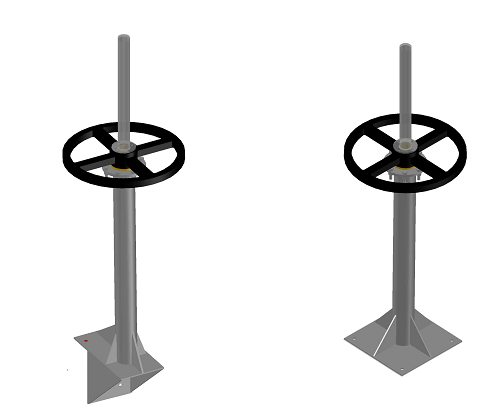
Standard spindles are 304 stainless steel and are sized in accordance with calculated tensile and compressive loads, which will be imposed while opening and closing the gate. The spindle is supported in the case of the penstocks by a Phosphor bronze bush fitted to the bridge piece. In the case of a wall mounted sluice gate the spindle will be supported by suitably spaced wall brackets. The wall brackets are fitted with a Phosphor bronze bush
Method of Operation
Wall mounted sluice and weir gates as well as telescopic bellmouths can be fitted, if necessary with the following
Method of Operation
If required a Perspex spindle cover tube could be fitted
Penstocks are manufactured with an integral bridge piece and are normally manually operated (with a handwheel) but the following can be fitted,
Drawing or operating methods
